Should I use a wooden spoon?
Everyone has heard that you shouldn't use a metal spoon in honey. Metal is said to react with honey and destroy its enzymes and medicinal properties. Often, it's also claimed that honey oxidizes due to metal, that honey can become toxic, and that only a wooden or plastic spoon is 'safe'.
That sounds plausible, but it's nonsense (sorry). There is no scientific evidence for it whatsoever. We've searched, and we've had AI search, but we haven't been able to find any.
Also consider that all equipment used by a beekeeper for processing honey, such as bottling tanks, settling tanks, honey ripeners, presses, mixing tanks, and bottling lines, are all made of stainless steel.
The reason is simple: stainless steel does not react with honey (nor with olive oil) and does not alter its composition. It has no effect on taste, quality, or natural properties. From that perspective, it is therefore safe to say that using a stainless steel spoon or butter knife has no negative effect whatsoever on the quality of honey.
The idea that metal would damage honey dates back to a time when honey was stored for long periods in pots made of reactive metals, such as ordinary iron (not stainless steel as is used now), tin, and, for example, copper vessels. However, honey is slightly acidic (around 4pH) and will corrode when in prolonged contact with such metals. So, the advice was not to store honey in metal vessels, and that later evolved into: 'do not use metal with honey'.
Modern stainless steel cutlery, however, has no effect on honey whatsoever. Using your teaspoon or butter knife to scoop a little honey out of your jar truly has no impact on the honey! At least, we cannot find the scientific basis for such a claim.
What about honey in hot tea? Can honey withstand heat?
No. Honey cannot withstand temperatures above approximately 40 °C. Above this temperature, the natural enzymes and aromatic compounds begin to break down slowly. This doesn't make the honey bad or unsafe, but it does lose a significant part of its character and health properties.
This means that honey in hot tea at 70 - 95 °C is primarily a natural sweetener with a pleasant taste, but not much healthier than sugar. The sweetness remains, but aromas and enzymes quickly diminish. Therefore, adding honey to hot tea with your wooden spoon is not very useful.
If you use honey in your tea for flavor and experience, it's best to add the honey to tea that has cooled down a bit. The cooler, the better, but anything above 40 °C is not very good for your honey. If you primarily want to sweeten, you can certainly use honey in hot tea; it's mainly a matter of what you prioritize.
What is forest honey?
Forest honey is honey from bees that collect nectar in a forested environment. The taste does not come from a single flower, but from the flora of the area: trees, shrubs, wild flowers, and herbs. As a result, forest honey can vary slightly by season.
Where does this forest honey come from?
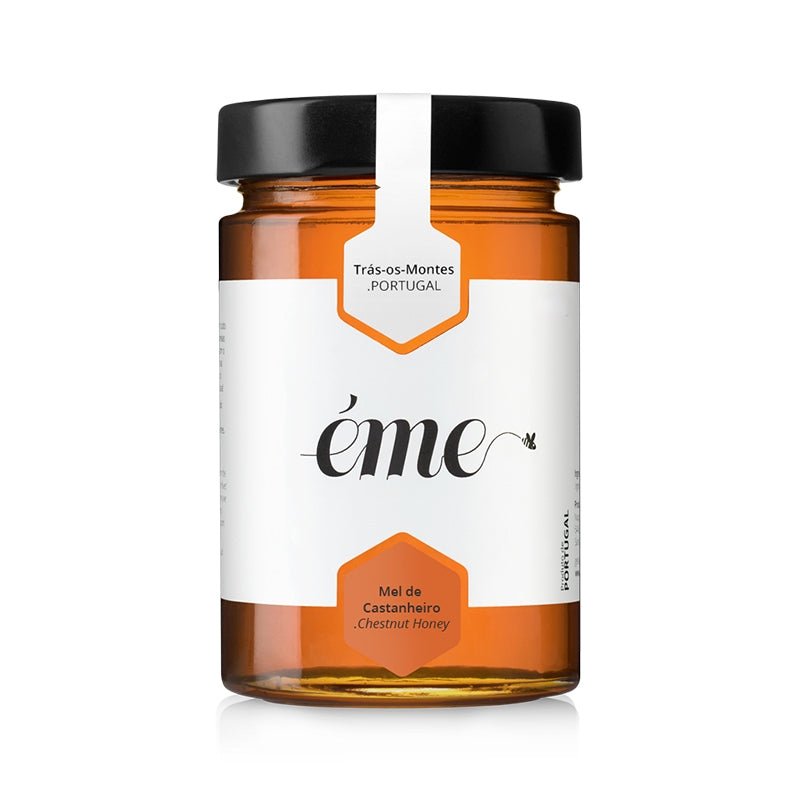
This honey comes from Éme in Santa Maria de Émeres, near Valpaços in Northern Portugal. The Trás-os-Montes region is rural and forested, with a varied natural environment for the bees.
Is this honey raw?
Yes. This honey is raw, cold-extracted, and unprocessed. It is not heated or industrially filtered.
How does this forest honey taste?
Soft and rounded, with light spicy and floral notes. It has more depth than regular blossom honey, but is slightly milder than pronounced chestnut honey.
What do you use this honey for?
For bread, yogurt, quark, oatmeal, fruit, cheese, tea, dressings, marinades, warm dishes, and desserts. This honey works particularly well with cheese, as its gentle sweetness beautifully contrasts with savory or spicy flavors.
Can you cook or bake with this honey?
Yes. Honey is widely used in the kitchen, for example in dressings, marinades, sauces, pastries, desserts, and with roasted vegetables or chicken. Heating does affect its aroma and taste. If you want to preserve the aroma as much as possible, it is better to add honey later or use it at a lower temperature.
Why is origin important for honey?
Because honey is a natural product where location, season, flowers, trees, and processing make a big difference. This forest honey has a clear origin: Éme from Santa Maria de Émeres, in the Portuguese region of Trás-os-Montes. Most honey in supermarkets is a mixture of European and non-European honey, increasing the chance of it being Chinese sugar water.
Why does honey crystallize?
Crystallization is a natural process. It does not mean that honey is bad. Raw honey can become thicker or more granular over time, depending on the natural composition of its sugars.
Can I liquefy crystallized honey again?
Yes. First, try stirring. You can use a stainless steel spoon or knife, or of course, your wooden spoon. If that doesn't work, place the closed jar in a bain-marie of lukewarm water and gently heat it to a maximum of 40°C. Do not use boiling water and preferably do not put honey in the microwave. Too much heat will compromise the scent and taste.
Is crystallization a sign of poor quality?
No. Crystallization is characteristic of real honey. It is a normal phenomenon and is related, among other things, to the natural ratio of glucose to fructose.
Can a baby eat honey?
No. Do not give honey to children younger than 1 year.
How do you best store honey?
Store honey in a dry, dark, and well-sealed place. Always use a clean, dry spoon. Honey does not need to be refrigerated.
How long does honey last?
Honey is one of the few foods that is, in principle, indefinitely shelf-stable. This is due to honey's unique composition: it contains little water, has a natural acidity, and inherently possesses antibacterial properties. This makes it difficult for bacteria and fungi to develop.
There have even been honey pots found in Egyptian tombs thousands of years old that were still edible. This underscores how exceptionally stable honey is by nature.
However, honey still has a best-before date indicated. This date is legally required and does not represent a strict expiry date. Honey is still safe to consume after the best-before date. However, color, taste, or texture may slowly change over time. A common change is crystallization. This is a completely natural process and is actually a sign of pure, unheated honey.
Why doesn't honey always taste exactly the same?
Honey is a natural product. Its taste depends on flowers, trees, season, weather, soil, and location. Precisely because of this, real honey can subtly differ from one harvest to another.