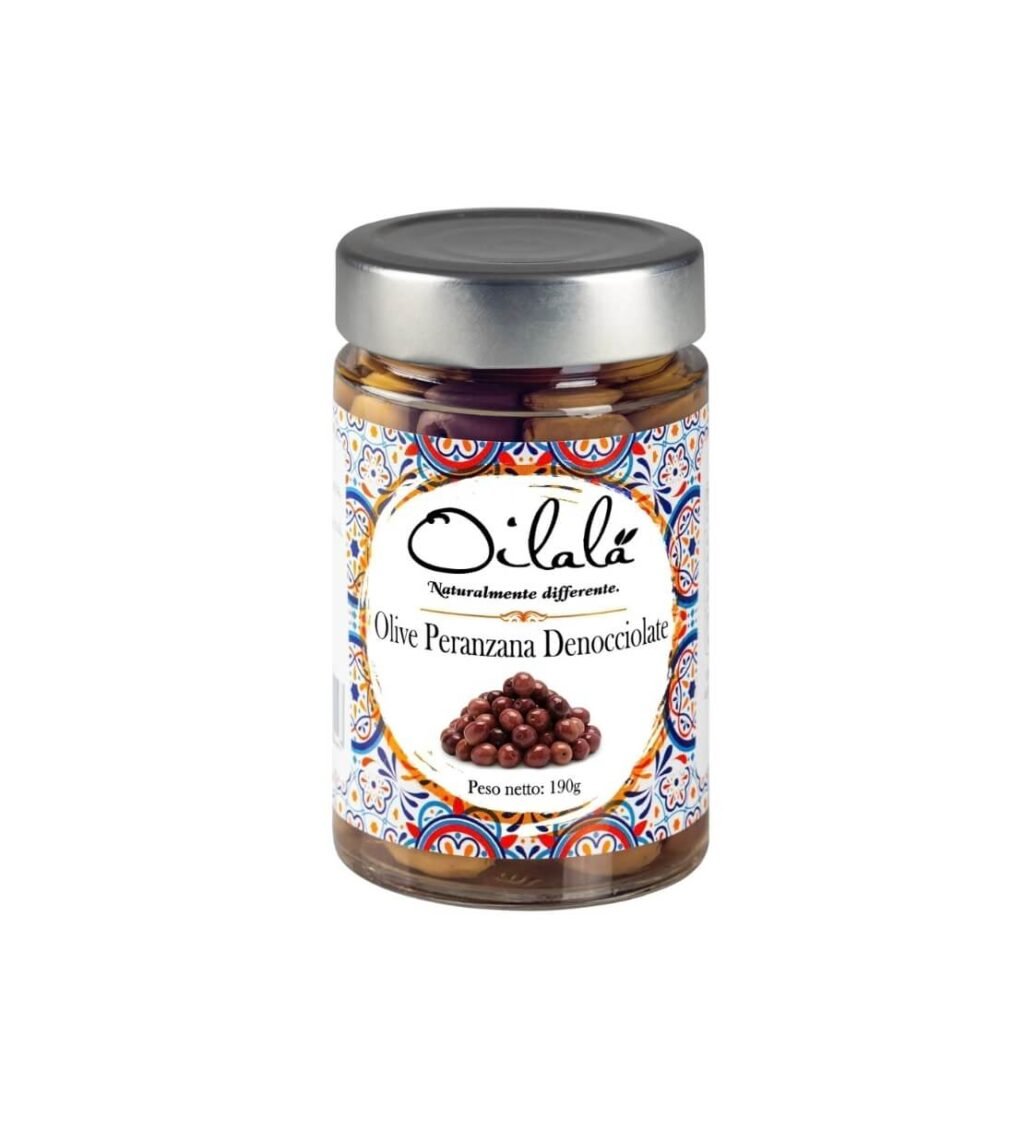
Peranzana olives pitted Italy
Pitted Peranzana olives from Puglia, harvested duringinvaiatura— the moment of ripening at whichtaste, texture and natural bitterness are in perfect balance. Traditionally partially debittered in salt water, with aintense, slightly bitter but elegant and real olive flavour.
Available in 190 g and 560 g.
Couldn't load pickup availability
Product details
Product details
Packaging & contents
190 g jar– drained weight ± 110 g
560 g jar– drained weight ± 330 g
Origin
Puglia (Apulia), Italy
Olive variety
Peranzana
Harvest time
Invaiatura– the transitional phase from green to purple, ideal for high-quality table olives. In Puglia, southern Italy, this is usually the period from mid- to late October.
Processing
Traditionally debittered in lightly salted water (salamoia)
Without the use of chemical accelerators
Pit
Pitted
Ingredients
Peranzana olives (63%), water, salt
Contains: lactic acid, ascorbic acid
Save
Store in a cool, dark place.
Keep refrigerated after opening and consume within 1 week.
Uses & Applications
Uses & Applications
These Peranzana olives have apronounced but elegant tasteand are widely applicable.
Suitable for cold use
Perfect as an aperitif, with drinks, in salads or neat with extra virgin olive oil and fresh bread.
Suitable for hot preparations
Very suitable in pasta, on pizza, with meat and fish dishes and in Mediterranean marinades.
Flavor profile
Flavor profile
Texture
Relatively small olive with thin skin and firm flesh.
Taste
Intense and aromatic, with anatural, refined bitternessand a clean aftertaste.
Style
Classical Apulian: pure, uncontrived and distinct.
Share

Why this product is special
These classic Apulian (Puglia, in southern Italy) olives are naturally ripened and traditionally debittered with saltwater. So, not chemically treated like supermarket olives.
These Peranzana olives come from Puglia , a region where olives have been a staple in everyday life for centuries. They are harvested during invaiatura : the brief, crucial period in autumn (usually around October) when the olive changes color from green to purple. It is precisely during this transitional phase that flavor, texture, and natural bitterness are perfectly balanced.
As the olive ripens, its composition changes. Green olives are firmer and more bitter, while more mature purple olives become softer and rounder. Harvesting during invaiatura creates an olive that is distinct and aromatic , yet remains elegant and edible . This is reflected in a firm bite, a pure olive flavor, and a refined bitterness.
After harvesting, the olives are debittered in a traditional way in lightly salted water ( salamoia ). This natural process takes time, but preserves the olive's character. The bitterness is gradually reduced without diminishing the flavor. The result is a full, pure olive flavor with depth and a clean finish.
The Peranzana olive is relatively small and has a thin skin, making it particularly suitable for this traditional processing. Pitting allows you to fully and safely savor each olive, without distraction. This makes them ideal for eating plain with drinks or an aperitif, or in salads, pastas, and Mediterranean dishes.
In short: these are authentic Southern Italian table olives , consciously harvested at the perfect time and processed with care. Not geared towards speed or volume, but true to flavor and tradition—and you can taste it.
Green and black (actually more purple) olives are the same. The later in the season, the more purple the olives become. Green olives are harvested in September/October. If you leave them hanging until late November, December, or even January, they will become increasingly purple until they are so dark purple they appear black.
The transition from green to purple is due to substances in the skin and flesh. Green olives are rich in chlorophyll, while purple olives are richer in anthocyanins, the substances that determine their dark color. Harvesting should take place when the olives have precisely the right ratios of polyphenols, chlorophyll, anthocyanins, and, of course, oil. The earlier you harvest, the greener the olives, the firmer the flesh, the higher the antioxidant (polyphenol) levels, but the more bitter the olive. When pressed into oil, the fruitier, more intense, and grassier the olive oil smells and tastes. The longer you wait, the purpler the olive, the sweeter, softer, and less intense the olives and the olive oil will be. The quality also decreases because, among other things, the polyphenol content decreases.
Our top-rated olive oils
-
Organic Extra Virgin Olive Oil Caixeiro Bag in box Portugal
4.8 / 5.0
(40) 40 total reviews
Regular price From €38,95 EURRegular priceUnit price €19,48/L€0,00 EURSale price From €38,95 EUR -
Caixeiro Signature Organic Extra Virgin Olive Oil 500ml Portugal
4.6 / 5.0
(10) 10 total reviews
Regular price €19,50 EURRegular priceUnit price €39,00/L€0,00 EURSale price €19,50 EURSold out -
Organic Extra Virgin Olive Oil Health Claim 500 ml Italy
4.9 / 5.0
(9) 9 total reviews
Regular price €22,95 EURRegular priceUnit price €45,90/L€0,00 EURSale price €22,95 EUR -
Organic Extra Virgin Olive Oil Health Claim 500ml Mix Greece
5.0 / 5.0
(3) 3 total reviews
Regular price €29,95 EURRegular priceUnit price €59,90/L€29,95 EURSale price €29,95 EUR