Refined olive oil. Really?
Share
Olive oil is an essential ingredient in our kitchens and is known worldwide for its numerous health benefits. But not all olive oil is created equal. In the Netherlands, you can buy three different types of olive oil: "extra virgin" olive oil, "virgin" olive oil, and regular olive oil (which is refined oil). It's crucial to understand why extra virgin olive oil is preferable to "virgin" olive oil, and why you should avoid "olive oil," the refined variety.
What is refined olive oil?
We've all heard of refining. Take refined granulated sugar, for example. Refining is a process that removes impurities and unwanted substances from a raw or unpurified substance to produce a purer end product. Essentially, refining is purifying. For example, refining raw iron ore produces beautifully pure steel that can be used to make beautiful cars, and raw, brown sugar beet pulp can be turned into a beautiful white sugar cube.
Refined olive oil is purified olive oil. It sounds like pure coffee, but it isn't. Why would you want to purify olive oil?
Good quality extra virgin olive oil is olive oil extracted directly from the freshest possible olives, pressed within a few hours of harvesting. The resulting oil is fresh extra virgin olive oil. You can filter this fresh and super-healthy extra virgin olive oil to remove small amounts of water and pulp, but that's all you need to do. In fact, you shouldn't do anything else! So, which olive oil needs to be refined?
Lampante olive oil and Pomace olive oil
Olive oil has been consumed for over 6,000 years, and we know that in Roman times, for example, olives were first crushed under large, rotating stones. Then, they placed the pulp in flat wicker baskets, piled it high, and topped it with a heavy stone to produce the first pressing. This was good quality extra virgin olive oil. Virgin oil because it wasn't treated.
Pomace olive oil
Then, boiling water was poured over the pulp left after pressing, and the olives were pressed again. Because of the hot water, the second pressing was of poorer quality and more contaminated. This oil, obtained from the second pressing of the olive remains, skins, and pits, is called pomace olive oil. It is of poor quality and not suitable for consumption. However, some documents have been found that this pomace oil was indeed consumed by the slaves.
That second, and perhaps even third, pressing is still done today. The pulp is bought by a chemical company, which chemically extracts the remaining oil using solvents like hexane. But what do you do with that pomace olive oil you get, which isn't suitable for consumption? Refine it and still sell it as olive oil. Seriously.
Lampante olive oil
Even poor-quality olives, for example, from a poor harvest or olives ravaged by pests, moldy, rotten, etc., were pressed in Roman times and are still pressed today. The olive oil extracted from them was, of course, inedible, but it was oil nonetheless, and they could use it as lubricant and fuel for their torches and lamps. This is where the term "lampante olive oil" comes from.
These days, olives from a poor harvest—overripe, rotting olives that have lain on the ground too long and been affected by mold, bacteria, and pests—are still pressed. But why? We now have better lubricants made from petroleum and electricity for our lamps, so what are we supposed to do with lampante and pomace oil?
The brown pulp from the second press and the pressing of pressed, rotting olives was and is not suitable for consumption. It stinks, is terribly foul, the pH is so acidic it will corrode your intestines, and the mold and bacteria make you sick. Yet, someone has come up with the idea of selling this pulp as food. You just have to refine it. Seriously.
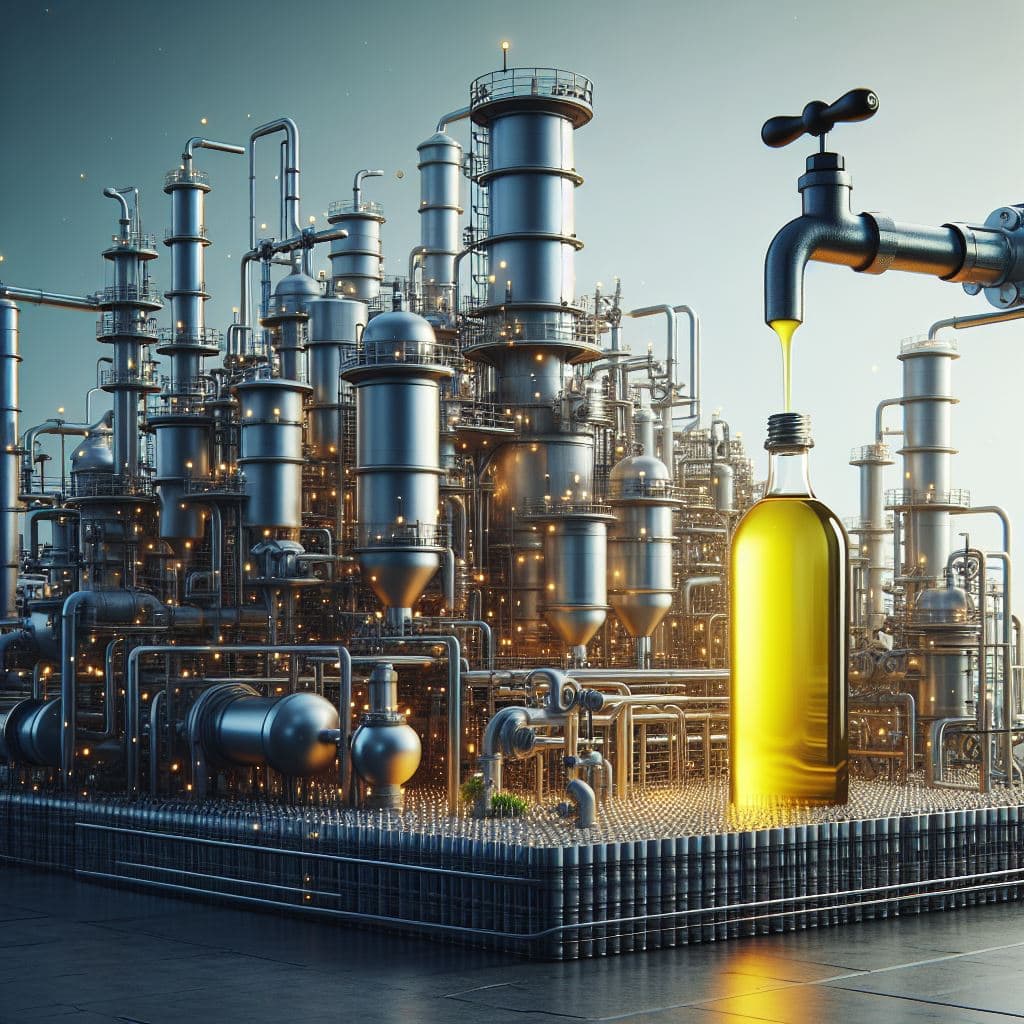
Production of refined olive oil
How exactly is refined olive oil produced? Take a look behind the scenes of the olive oil refining process.
Step 1: Extraction of Raw Olive Oil
The first step in the production of refined olive oil is pressing the (rotting) olives. This is usually done mechanically, such as pressing or centrifuging. The resulting pulp, called raw lampante, is full of contaminants. As mentioned, it's inedible and must first be filtered and purified through a process of chemical and physical methods.
Step 2: Deacidification
The acidity of the crude oil is reduced through a neutralization process. The oil is treated with an alkali, such as sodium hydroxide. This substance reacts with the free fatty acids in the oil, converting them into soap, which can then be easily removed.
Step 3: Bleaching
After deacidification, the oil is decolorized to remove unwanted colorants. This is usually done by pressing the oil through a filter containing a type of activated carbon that absorbs the colorants. This process helps produce a consistently clear oil that is attractive to consumers.
Step 4: Deodorize
The oil still smells incredibly bad, so now comes one of the most important steps in oil refining: deodorization. This involves heating the oil to high temperatures under vacuum conditions to remove volatile compounds responsible for unwanted odors and flavors.
Step 5: Desliming
The degumming process removes phospholipids, mucilage, and other colloidal substances that can affect the clarity of the oil. This is often done by treating the oil with an aqueous solution and then centrifuging it to separate the impurities.
Step 6: Bleaching
While bleaching is sometimes combined with decolorization, it can also be a separate step. Bleaching involves passing the oil through a filter containing clay-like materials that absorb further dyes and impurities.
Step 7: Winterization
Typically, refined olive oil undergoes a process called winterization to ensure it remains stable at low temperatures. This process involves cooling the oil to crystallize solid fats, which are then removed. This prevents the oil from becoming cloudy in the refrigerator.
End product
The final product is a neutral oil, completely stripped of all its health benefits, devoid of flavor, odor, or color. Therefore, some color, odor, and a little flavor are added through chemical manipulation. However, refined oil lacks all, and I mean all, the health benefits of extra virgin olive oil. Any antioxidants or other bioactive compounds still present in the sludge were completely removed during the refining process.
After this extensive series of treatments, the refined oil is ready, but as mentioned, it cannot be called "olive" oil. After all, it doesn't even remotely resemble olive oil. A solution has been found for that, too.
To be allowed to label "olive oil," the producer must, by law, mix at least 5% extra virgin olive oil with the refined oil. And then you can label the bottle as "olive oil." As Marijn Frank of the Dutch Food and Consumer Product Safety Authority (Keuringsdienst van Waarde) puts it: "That's pretty bizarre!" And it certainly is. It really is.
Is refined olive oil healthy?
No. Refined olive oil is very unhealthy! While extra virgin olive oil consists mainly of monounsaturated fatty acids, and the organic compounds in the olive oil are protected by a high level of polyphenols (antioxidants), refined oil contains much more polyunsaturated fats and no antioxidants.
Heating the sludge breaks down even the very last organic compounds in the oil, which is extremely unhealthy. Organic compounds include proteins, fats, and carbohydrates. They are the building blocks of living organisms.
When these proteins, fats, and carbohydrates are heated too much, their organic bonds break and they become free radicals. Free radicals are highly reactive atoms or molecules with unpaired electrons. These can damage cells and tissues through uncontrolled reactions with other molecules in the body, leading to all sorts of reactions such as inflammation and cell damage. This is because oxidants alter molecular structures, causing cells to malfunction, divide uncontrollably, and even die.
Refined olive oil is an oxidant that attacks your body at the cellular level and can cause all sorts of ailments. Want to bake or fry with it?
The contrast with extra virgin olive oil couldn't be greater. Extra virgin olive oil is actually an antioxidant and protects your body against oxidants at the cellular level. That's why you should avoid refined oils and use extra virgin olive oil. Not just for your salad, but also for baking and frying in pots, pans, and the oven!
What is Extra Virgin Olive Oil?
Extra virgin olive oil is obtained by washing fresh olives within a few hours of being picked from the tree and then cold-pressing them. Strict EU regulations stipulate that the oil must never exceed 27 degrees Celsius during this process, which is why it must still be cold-pressed (a second pressing with hot water, as was once done, is no longer used). It is then usually filtered, and the extra virgin olive oil is ready.
The use of heat or chemical treatments is strictly prohibited. All these processes degrade the quality of extra virgin olive oil, and it can lose its natural flavor, aroma, and, most importantly, its nutritional value. To be classified as "extra virgin," olive oil must meet strict criteria, including low acidity (less than 0.8%) and the absence of sensory defects (the oil must have a fresh, fruity aroma).
This extra virgin olive oil is pure and natural and packed with antioxidants like polyphenols, tocopherols, oleuropein, vitamin E, oleocanthine, healthy fats, and anti-inflammatory and health-promoting properties. This extra virgin olive oil belongs in your kitchen, on the table, and in your medicine cabinet. Especially in the Netherlands. Use it in, on, and with all your dishes. Cook with it, enjoy it pure, or bake and roast with it in pans and ovens.
But you can use refined oil for hot applications, right? It says so on the label: "for hot applications."
In the supermarket, you see a lot of olive oil in transparent, often plastic, bottles. The labels are full of completely nonsensical terms like traditional olive oil, blended olive oil, classico, classico original, gentle, mild, light, robusto, cucina delicata, etc. It's all marketing and utter nonsense. The label often also says "suitable for hot use." That's also complete nonsense!
It's said that the smoke point of refined oil is quite high (around 230 degrees Celsius), making it safe for frying and roasting. Nothing could be further from the truth. Refined oil is not safe for any purpose, not even for frying or roasting!
The smoke point of refined olive oil may be slightly higher than that of extra virgin olive oil (between 190 and 220 degrees Celsius, depending on the quality), but the problem is that refined oil is already bad for you even when cold because it's no longer stable due to the heating and the chemical refining process. The organic compounds have already been broken down, and the oil, even in the bottle, is an oxidant for your body. It's just as bad for you as heavy air pollution and smoking, which are also oxidants. So the oil is already a health hazard before you even throw it in the pan.
Marketing cleverly uses the smoke point to indicate an oil's heat tolerance, but a scientific study has shown that the smoke point is not a good indicator of whether an oil remains stable when heated. Click here for more information about this.
Whether an oil will oxidize depends entirely on the quality of the olive oil, its oxidative stability and UV coefficients, combined with its total polyunsaturated fat content. It has nothing to do with its smoke point. Click here for that study.
The bottom line is that even though the smoke point of refined oil is slightly higher, it is a very poor quality oil and therefore the unhealthiest choice for any application, especially for baking and frying.
Although the smoke point of premium extra virgin olive oil is around 190-220°C, which is considerably higher than, for example, butter but slightly lower than refined oil, research shows that the antioxidants in extra virgin olive oil keep it relatively stable at normal cooking temperatures.
The above also applies to sunflower oil and all other vegetable oils we can buy in the supermarket, such as rapeseed oil, peanut oil, soybean oil, canola oil, and unfortunately, avocado oil. These are all refined oils, very unhealthy, and not suitable for heating. But we all do that anyway! Real, fresh sunflower oil is delicious, healthy, and great for cold use on salads, etc., but also excellent for baking and frying. Unfortunately, we don't sell it in our supermarkets. They only sell cheap, refined sunflower oil. It smells and tastes like nothing.
Vegetable oil in the supermarket
The Dutch Food and Consumer Product Safety Authority (Keuringsdienst van Waarde) produced a great program about vegetable oil in the supermarket. Salad oil, sunflower oil, rapeseed oil, peanut oil, soybean oil, rice oil, wok oil, coconut oil, avocado oil, etc. What's the difference? There is none. They've all been refined and therefore completely stripped of all their health benefits and the qualities that distinguish one from the other. They're all the same, and all very unhealthy.

Refined oil is unhealthy!
Refined oils promote inflammation in your body. A recent study from the University of California, Los Angeles (UCLA) has shown that certain refined vegetable cooking oils may therefore influence the development and progression of cancer. Read the article here . and here the study.
Conclusion
It's true. Refined olive oil is made from rotting and moldy olives, and it's truly bizarre that adding 5% extra virgin olive oil allows you to put "olive oil" on the label again. As far as we're concerned, it's a waste of extra virgin olive oil.
Although the oil no longer contains impurities after refining and has a slightly higher smoke point, the refining process has made it an oxidizer for your body. Therefore, there's no reason to use refined oil other than to lubricate your hinges or bicycle parts.
Using refined oil can (will) lead to the formation of oxidants and toxic byproducts, which have harmful effects on the body through oxidative stress, cell damage, and inflammation, and can ultimately lead to chronic diseases. Why would you want that when you can also use healthy extra virgin olive oil?
Want to know more and hear it from someone else? Watch the Keuringsdienst van Waarde broadcast about olive oil (see below). The Keuringsdienst van Waarde shows that olive oil exists that's made from rotting olives, and that we in the Netherlands throw it in the pan en masse and eat it (yuck).

Click on the image for the episode of the Keuringsdienst van Waarde (Inspection Service of Value) about olive oil. Scroll to 9:38, where the Spanish olive grower proudly explains that he can even press lampante oil from rotten olives, but that he will never eat that oil himself. That oil is for other countries (e.g., the Netherlands). Scroll to 16:50 for the entire process of how refined olive oil is made and prepare to be amazed.